Saturday, 26 October 2013

4 REASONS WHY YOU ARE NOT FINANCIALLY IDEPEDENT YET


Since when I posted the article onWhat the jews teach their children about money, I have received a lot of emails from different people on issues of personal finance. One thing that constantly runs through all the emails I get is the need for financially freedom or financial idepedence. In a recent seminar I had, a participant called Stella Nailantei posed, ‘’ I got a fairly paying job after graduating with a bachelors degree five years ago. Back then, I had a plan to be financially independent after 7 years. I only have two more years to go and I don’t see my dream coming true, what advice do you give a person like me?”  in a bid to answer her, I found myself writing this article which I believe will not only motivate her but also millions of people like Stella who are in pursuit of financial freedom
You don’t have a spending plan.
You have often heard that failing to plan is planning to fail. Well, do you have a spending plan? If not then you are on the road to financial disaster. We live in a world of limited resources and unlimited wants. Its only logical the that you have a carefully considered plan on how each shilling that you make will be spend. According to best selling author, Larry Winget,  one of the reason you are broke is simply because you are stupid. You know where money comes from and you spend it like it will fall from the sky the minute you need it. The famous Pit-bull of Personal Development argues that only fools spend what they have today with little or no regard for what they will do tomorrow. By not having a budget, you also spend your money on non priority items at the expense of priority items. I have seen friends going out to “have fun” with all the money they have when their house rent has not been paid. Once they have fun, they come back to reality the following day and are then forced to borrow in order to pay for the house rent. If you want to achieve financial independence then, start creating a budget and more importantly have the discipline to follow it through.
You spend more than you earn
The most basic financial principle you can grasp is that you have to spend less than you earn. Spend the whole of it, and you are living for your stomach, spend more than you earn and you will live in debt forever. If  it’s not possible to reduce your expenses to meet your income, you have the option of increasing your income. If you are employed, try doing some side business, try utilizing your weekends for some productive and income generating activities. If you can reduce your expenditure or increase your income, then what I can tell you is that your financial independence dream will remain just a dream.Learn Invest Deputy Head, Allison Kade says that the reason you are broke is really because you don’t have enough income to meet your expenses. You want a big house, a flashy car and a life of luxury but your salary can barely support a single trip to the beach. Winget says that in order to break free of your financial limitations, you need to stop getting by and start getting ahead. Get out of your comfort zone and do something about your financial goals.
You Don't Have a Savings Account
Another reason you are far from financial independence is because all your money goes into your Personal consumption account. Having all your income deposited straight into this account encourages you to overspend. As long as you are able to withdraw your cash, you will be free to do so until there is nothing left. "After all," says Kade, "the money is right there, ripe for the spending, and saving cash for the future requires transferring it separately to your savings account." She notes that a better alternative would be to set up automatic deposits straight from your pay cheque into your various savings accounts. Most local banks offer this option. As long as you can access that money in your bank account, even via MPESA, then stop lying to yourself that you are saving. It doesn’t work that way.

You're in trapped in  bad debt
Do you want to be financially free? Then, avoid bad debts. Debt is like a hole that you keep digging until it becomes so deep that you can’t get out. "Debt sucks," says Stella Nailantei, a participant in a seminar I recently conducted. " It's the most uncomfortable feeling in the world. I usually cant wait to pay up and be done.  Most of us are trapped in the worst form of debt, consumer debt. This is debt that has been incurred for non priority items as explained above or for consumption purposes. Truth of the matter is, loans should only be taken either for business or investment or only  on emergencies of epic proportions.In stop taking loans for lifestyle, I explained the difference between good and bad debt and how you can use a loan to grow your wealth and move to financial independence.

 Kindly like my face book page Stars of the future  to join a community of winners who have opted to make a positive change in their lives.

Friday, 13 September 2013

WHAT YOU NEED TO KNOW ABOUT UWEZO FUND

 Posted by Zack Mwema,


What is Uwezo Fund?
It’s a revolving fund that was established by the government to provide cheap credit to the youth and women of this republic.Uwezo Fund stems from the outcome of the last general election during which His Excellency the President made a pledge to allocate the Kshs. 6 Billion meant for Presidential run-off to youth and women groups.
Why the Uwezo Fund?
The objectives of the Fund are:
  1. To expand access to credit for the promotion of youth and women businesses and enterprises at the constituency level and thereby enhance economic growth towards the realization of the goals of Vision 2030;
  2. To generate gainful self-employment for the youth and women;
  3. To model an alternative framework in funding community driven development.
Who qualifies as a beneficiary of the Uwezo Fund?
Any Registered Youth and Women groups qualify to be a beneficiary of the Uwezo Fund.
The fund doesn’t target individual borrowers and so you must be in a registered group.
What is the eligibility criterion for the Uwezo Fund?
For women and youth groups to qualify for the Uwezo Fund, they must:
  1. Be registered with the Department of Social Services or the Registrar of Societies with a membership of 9 – 15 members.
  2. The youth group membership must be between 18 and 35 years of age.
  3. Preference will be granted to groups that have been in existence for at least six (6) months.
  4. Be based and operating within the Constituency it seeks to make an application for consideration.
  5. Operate a table banking (Chama) structure where members make monthly contributions according to the groups’ internal guidelines (evidence of monthly contributions will be a requirement).
  6. Hold a bank account in the name of the group
  7. Recommended by the Chief of the location.
How will the Fund operate?
1)      At the National level, a National Uwezo Fund Oversight Board shall provide overall management, design and oversight of the Fund. The Board is supported by a Secretariat.
2)      Uwezo Fund will be administered through the Constituency Development Fund framework in all 290 constituencies. The Constituencies Development Fund Committees will in turn constitute the Constituency Uwezo Fund Management Committees to oversee implementation of the Fund.
a)      Representatives of Women, Youth and person with disability will be part of the Constituency Uwezo Fund Management committees.
b)      The Fund will operate as a revolving Fund ensuring continuity and sustainability.
c)       Borrowing groups will be expected to apply Table Banking principles.
d)      The Fund will be organically linked to 30% public procurement spend preference closing the loop between access to opportunities for enterprise development and supply side capabilities.
How can one apply for the Uwezo Fund?
  1. The National Uwezo Fund Oversight Board in collaboration with the Ministry of Devolution and Planning is preparing to roll out Uwezo Fund Capacity Building Programme to prepare potential beneficiaries of Uwezo Fund.
  2. Interested Youth and Women groups must be trained for an initial period of three months before they can apply for Uwezo Fund. However, Uwezo Fund Capacity Building Program will be available for one year.
  3. Uwezo Fund Capacity Building Program will focus on four key areas namely;
a)      General Information on Uwezo Fund
b)      Business Development Services and Mentoring
c)      Table Banking
d)     Access to 30 percent Public Procurement tender opportunities for Youth, Women and persons with disability.
e)      Once the Fund is officially launched, interested registered groups of youth and women can visit the nearest Constituency Development Fund office to register for the Uwezo Fund capacity building program.
How much money is accessible from the Uwezo Fund?
The amount given shall be based on assessment by the Constituency Uwezo Fund Management Committee but will not be more than Kshs. 500,000 per group.
Is this the same as Youth Fund or the Women Fund?
No, this is a separate Fund but will complement the other two existing Funds.
Is it a loan of a grant?
Uwezo Fund is a loan. Youth and Women groups who will access the Fund will have a grace period of six (6) months and it will be repayable in eight installments. There is no interest chargeable, but a 3% administration fee will be charged.
How do Persons with Disabilities benefit from the Uwezo Fund?
Application for funds by Youth and Women living with Disabilities will be given special consideration.
You can follow more on the Uwezo fund website by clicking here- UWEZO FUND WEBSITE

Monday, 2 September 2013

MAY YOU BE INVESTING IN A PYRAMID SCHEME THINKING THAT YOU GOT THE REAL DEAL?

 Article researched and Posted by Zack Mwema


How many of us remember the famous DECI scheme that had promised to turn every one into a millionaire? How many of us or our unsuspecting friends were tricked into investing into the unscrupulous scheme? Well, the pyramid schemers are back and this time they are wiser and have packaged their products in a way that is not easier to detect the fraud. In WHAT THE JEWS TEACH THEIR CHILDREN ABOUT MONEY(,http://smartmoneymanagers.blogspot.com/2013/07/what-jews-teach-their-children-about.html) I talked about the need to teach our children at an early age about money; spending, investing, giving, tithing and saving. The topic triggered a lot of questions and compliments and I got massive response from different people across the globe. One particular guy requested me in our facebook page Stars Of the Future  to publish an article about pyramid schemes, his mere mention of the term evoked mixed reactions and I decided to set the record straight  this article is a culmination of that debate.
A Pyramid scheme is a fraudulent investing plan that has unfortunately cost many people worldwide their hard-earned savings. The concept behind the pyramid scheme is simple and should be easy to identify; however, it is often presented to potential investors in a disguised or slightly altered form. For this reason, it is important to not only understand how pyramid schemes work, but also to be familiar with the many different shapes and sizes they can take.

The Scheme
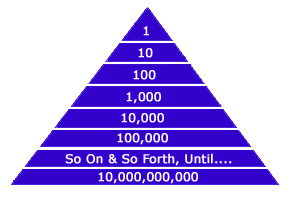
As its name indicates, the pyramid scheme is structured like a pyramid. It starts with one person - the initial recruiter - who is on top, at the apex of the pyramid. This person recruits a second person, who is required to "invest" for instance Ksh 10,000 which is paid to the initial recruiter. In order to make his or her money back, the new recruit must recruit more people under him or her, each of whom will also have to invest Ksh 10,000. If the recruit gets 10 more people to invest, this person will make Ksh 90,000 with just a Ksh 10,000 investment.

The 10 new people become recruiters and each one is in turn required to enlist an additional 10 people, resulting in a total of 100 more people. Each of those 100 new recruits is also obligated to pay Ksh 10,000 to the person who recruited him or her; recruiters get a profit of all of the money received minus the initial Ksh 10,000 paid to the person who recruited them. This is what the former Central Bank of Kenya Governor Jacinta Mwatela described as one fool, recruiting ten more fools in order to pay the first fool. The process continues until the base of the pyramid is no longer strong enough to support the upper structure (meaning there are no more fools to recruit)
The Fraud
The problem is that the scheme cannot go on forever because there is a finite number of people, (read fools) who can join the scheme (even if all the people in the world join). People are deceived into believing that by giving money they will make more money ("with an investment
 of just Ksh 10,000, you will receive Ksh 90,000 in return"). But no wealth has been created; no product has been sold; no investment has been made; and no service has been provided. It becomes easy when the Pyramid Schemers pay the first batch of people, this is because they now have vocal ambassadors and witnesses who have been paid and hence can convince people that scheme is a legitimate one. The fraud lies in the fact that it is impossible for the cycle to sustain itself, so people will lose their money somewhere down the line. Those who are most vulnerable are those towards the bottom of the pyramid, where it becomes impossible to recruit the number of people required to pay off the previous layer of recruiters. Though the early recruiters are not spared either because studies show that they also re invest back their first earnings in a bid to make mega bucks. This kind of fraud is illegal in most countries throughout the world. It is estimated that 90% of people who get involved in a pyramid scheme will lose their money.

Fraud Disguised
Because people are attracted to the idea of making a quick buck with very little effort, many different forms of disguised pyramid schemes have succeeded in fooling people. Despite the illusion of legality presented by these revamped schemes, they are still illegal. It is thus important to recognize the characteristics of such so-called investment plans.
Many schemes will adopt the guise of gift-giving or loans that take place in investment clubs because none of these activities are technically illegal. Others come in the form of Savings and Credit Cooperatives and others as Micro Finance institutions. They take advantage of our country's weak regulatory framework and take advantage of corrupt networks to defraud Kenyans.

 TYPES OF PYRAMID SCHEMES

Multi-Level Marketing (MLM)
Legal multi-level marketing (MLM) , like GNLD involves being recruited in order to sell a product or service that actually has some inherent value. As a recruit, you can make a profit from the sales of the product or service, so you don't necessarily have to recruit more salespeople below you. And while you may be encouraged to recruit other salespeople whose sales would give you more profit, you can stick to just selling the product directly to the consumer if you choose. A pyramid scheme MLM, however, will most likely sell a product with no independent value. The product could take the form of reports of some kind, for example, or mailing lists. In this kind of pyramid scheme, you would be required to recruit new members into the MLM in order to make a profit and keep the MLM alive. Joining the MLM is the only reason anyone would buy the products sold by this pyramid scheme.

Ponzi Schemes
Named after Charles Ponzi, who ran such a plot from 1919-1920, the Ponzi scheme
 is a fraudulent investment plan. It is not necessarily a pyramid, which is hierarchical. In a Ponzi scheme, there is one person who takes people's money as an "investment" and does not necessarily tell them how their returns will be generated. As such, the people's return on investment could be generated by anything; it could come from money taken from new investors - which means new investors essentially pay off the old investors - or even from money made by gambling in Casinos. They usually tell ignorant Kenyans that they invest in offshore trade and have business in tax free Havens like the Jersey Island.  This type of Pyramid Scheme is very common in Kenya. I recently came upon one in Kenya that offers shares to unsuspecting ‘Investors’ without disclosing how the valuation of the shares was arrived at, how their money will be invested and what assets the company currently own. This is the most difficult type to identify; this is because they hire smart marketers and know how to network with opinion leaders in any society so as to earn the confidence of the locals.

Foreign Exchange Pyramid Schemes
Last year, a friend of mine tried recruiting me into a scheme called Bullish Trade. The company was allegedly registered in UK and dealt with buying and selling of foreign currency especially Dollars. One was required to register with any amount up from Kshs 50,000 and used to earn e-currency based on the volume of trade and the e-currency could not be easily converted into Cash. The business was conducted on a digital platform and as soon as the schemers had recruited enough fools and hit the bottom of the pyramid, they closed the website and disappeared leaving many Kenyans doing the usual “Serikali saidia “I had already told my friend that it was a scam and that he will soon lose his money. He has never picked my phone ever since and I suspect he is not sitting pretty wherever he is.

Conclusion
It is easy to see how a pyramid scheme can work, but participating in it (regardless of the form in which it is presented) involves deception and fraud because not everyone will receive the money that is promised in return. As with any other investment plan you consider entering, it is important to ask the right questions. How will this money be invested? What is the rate of return? Who will be investing it?  Where does this company come from? Who are its directors? Do the directors have a track record that can be trusted? If it’s a Ponzi scheme, ask them, what investments do they currently own? Which company valued their assets to determine the pricing of their units? Can they give you a prospectus? Talk to professionals and do your research before placing your money anywhere, that is exactly what we . And always remember that if a plan promises you'll get rich quick with no risk or doesn't tell you how your money will be invested, you should raise a red flag and exercise caution before getting on board. Kindly comment or drop me an email on zaxmwema@gmail.com 
 . You can also click this link https://www.facebook.com/starsofdafuture to like my facebook page as we talk about more about investments and Money .

Saturday, 10 August 2013

MISTAKES YOU CANT AFFORD IN A PATNERSHIP STARTUP.

  Article researched and Posted by Zack Mwema, zaxmwema@gmail
 
 I was just looking at the kind of products that the Youth enterprise fund offers to youth of this country and one of the items which was strikingly missing in their portfolio was the need to coach and mentor youth who want to get into business either as individuals or as partners.I have always said that offering the youth with loans without proper training and mentorship is a recipe for a financial disaster. Anyway, let me do what I can to bridge the gap.
The road to a business venture usually starts with an itch that won’t go away. From the idea comes a name, a station of work, and a start-up business. Sometimes the need for a partner to help push the business forward will come up. It could be the skills and experience that need a boost. It could be the finances or the networks that need a kick. In some situations, the partnership is formed right at the start. The initiators of such a business partnership could be college mates like Larry Page and Sergey Brin of Google, or Bill Helwett and Dave Packard of HP. They could also be brothers like in the Tuskys Supermarkets chain, or the Dassler brothers (Adolf Dassler and Rudolf Dassler) of the Adidas  and Puma sports footwear fame. Getting into a partnership is one of the alluring offers that the business environment proposes for young entrepreneurs. It is an arrangement that must be carefully managed, yet young entrepreneurs frequently leave it to trust. There are risks involved in being in a partnership, just as much as there are benefits. The risks range from the normal and expected, such as occasional conflicts over decision making, to major issues like getting thrown out of your own company. It happens; the late Apple founder was once thrown out of a business he had created.
So, how do you secure yourself in a partnership? How do you keep your vision for the venture on track even when your voting rights have gone down by virtue of taking on a partner? These are some of the questions that any young person getting into a start-up partnership needs to answer before opening the door to a second party. Partnerships require a lot of balancing. The partners must know where the boundaries lie between their relationships as friends or relatives and as business partners. If they can’t separate the two, then there is bound to be trouble.
Usually, problems start when the profits begin to pour in. This is particularly so when the family or peer partnership starts with very limited capital. At that level, the partners will have little to bicker about. For much of the time, they will focus their energies at getting to see the business venture work out successfully. Trust and friendship drive them.  Trust has a limited role when it comes to certain matters in business. The brother partners need a legal framework to give clear demarcations on where each partner belongs and what they can or can’t do. To ignore the legal aspects of the business’s administrative and ownership structure is a fatal move for any of the partners
What of partnerships in which one individual has the idea or the skill and other brings in the capital or the market networks? How do you go about running your company when your partner is a well-established business person who provided 80 per cent of the start-up capital while you came up with the concept and made it a workable reality? Are the two or you equal partners? Who makes the final decisions? You the founder or the money guy?
According to a senior marketing and business management lecturer, Dr Okonga-Wabuyabo, It is possible to quantify the idea, the skill or the expertise. The partners will have to sit beforehand and come up with financial figure equivalents of the non-financial aspects of the partnership. The non-financial figure equivalents will then be compared to the capital input of the other partner. From the comparison, a relationship ratio can be worked out. “The agreement must be put down in writing and a legal expert called in to oversee the signing of binding agreements,” advises Dr Okonga. There are common failures that experts would like you to avoid in your business start-up partnership. They include the following:
        I.            Failure to spell out the roles and responsibilities of each partner: Two people decide to work together with each offering a distinctive service into the venture. They both have a rough idea of what their responsibilities should be, but not the exact scope and breadth. Soon, they will be overlapping into the roles of each other while some things are left unattended.
      II.            Failure to harmonise the long-term goals of each of the partners: The fact that two or more individuals have entered into a partnership is not a guarantee that they will share similar visions for the business venture. In many cases, it happens that one partner is more forward thinking than the other or that one has a different approach to handling the long-terms operations. If the two approaches are not harmonized, the partners will experience negative tensions in the way that they work.
    III.            Failure to put in place a formal structure of resolving conflicts: The possibility of conflict with your partner is real. It could be a financial issue, an operational matter, or a technical decision. What matters is the way the conflict is handled. It is necessary to institute a formal structure of dealing with conflicts between partners. Absence of a legal documentation of the partnership: This is the most overlooked yet the most important aspect of forming partnerships. Many young entrepreneurs assume that when the partner is a brother, a college friend or room-mate, or an older and more experienced professional, then the chemistry is good enough. Wrong. Issues such as roles, share ownership, capital contribution, and how to part ways must be included in a signed agreement with guidance of a lawyer.
So before you and your partner pick that loan form from the youth enterprise fund, ask yourself; have you sealed all the possible loopholes that could jeopardize the existence of your startup? Have you scrutinized that partnership deed to make sure that the interests of both partners are well catered for. Please do. Les Brown, my favorite motivational speaker say, “Don’t be casual with life, you will end up a casualty “
Kindly visit my Blog, http://www.smartmoneymanagers.blogspot.com and let’s talk about money, wealth and business. Also like my Facebook page Stars of The Future and join thousands of youth who are determined to change their lives.