
How many of us remember the famous DECI scheme that had promised to turn every one into a millionaire? How many of us or our unsuspecting friends were tricked into investing into the unscrupulous scheme? Well, the pyramid schemers are back and this time they are wiser and have packaged their products in a way that is not easier to detect the fraud. In WHAT THE JEWS TEACH THEIR CHILDREN ABOUT MONEY(,http://smartmoneymanagers.blogspot.com/2013/07/what-jews-teach-their-children-about.html) I talked about the need to teach our children at an early age about money; spending, investing, giving, tithing and saving. The topic triggered a lot of questions and compliments and I got massive response from different people across the globe. One particular guy requested me in our facebook page Stars Of the Future to publish an article about pyramid schemes, his mere mention of the term evoked mixed reactions and I decided to set the record straight this article is a culmination of that debate.
A Pyramid scheme is a fraudulent investing plan that
has unfortunately cost many people worldwide their hard-earned savings. The
concept behind the pyramid scheme is simple and should be easy to identify;
however, it is often presented to potential investors in a disguised or
slightly altered form. For this reason, it is important to not only understand
how pyramid schemes work, but also to be familiar with the many different
shapes and sizes they can take.
The Scheme
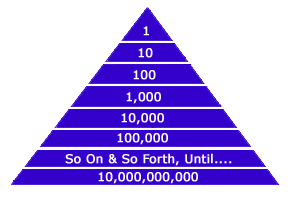
As its name indicates, the pyramid scheme is structured like a pyramid. It starts with one person - the initial recruiter - who is on top, at the apex of the pyramid. This person recruits a second person, who is required to "invest" for instance Ksh 10,000 which is paid to the initial recruiter. In order to make his or her money back, the new recruit must recruit more people under him or her, each of whom will also have to invest Ksh 10,000. If the recruit gets 10 more people to invest, this person will make Ksh 90,000 with just a Ksh 10,000 investment.
The 10 new people become recruiters and each one is in turn required to enlist an additional 10 people, resulting in a total of 100 more people. Each of those 100 new recruits is also obligated to pay Ksh 10,000 to the person who recruited him or her; recruiters get a profit of all of the money received minus the initial Ksh 10,000 paid to the person who recruited them. This is what the former Central Bank of Kenya Governor Jacinta Mwatela described as one fool, recruiting ten more fools in order to pay the first fool. The process continues until the base of the pyramid is no longer strong enough to support the upper structure (meaning there are no more fools to recruit)
The Scheme
As its name indicates, the pyramid scheme is structured like a pyramid. It starts with one person - the initial recruiter - who is on top, at the apex of the pyramid. This person recruits a second person, who is required to "invest" for instance Ksh 10,000 which is paid to the initial recruiter. In order to make his or her money back, the new recruit must recruit more people under him or her, each of whom will also have to invest Ksh 10,000. If the recruit gets 10 more people to invest, this person will make Ksh 90,000 with just a Ksh 10,000 investment.
The 10 new people become recruiters and each one is in turn required to enlist an additional 10 people, resulting in a total of 100 more people. Each of those 100 new recruits is also obligated to pay Ksh 10,000 to the person who recruited him or her; recruiters get a profit of all of the money received minus the initial Ksh 10,000 paid to the person who recruited them. This is what the former Central Bank of Kenya Governor Jacinta Mwatela described as one fool, recruiting ten more fools in order to pay the first fool. The process continues until the base of the pyramid is no longer strong enough to support the upper structure (meaning there are no more fools to recruit)
The Fraud
The problem is that the scheme cannot go on forever because there is a finite number of people, (read fools) who can join the scheme (even if all the people in the world join). People are deceived into believing that by giving money they will make more money ("with an investment of just Ksh 10,000, you will receive Ksh 90,000 in return"). But no wealth has been created; no product has been sold; no investment has been made; and no service has been provided. It becomes easy when the Pyramid Schemers pay the first batch of people, this is because they now have vocal ambassadors and witnesses who have been paid and hence can convince people that scheme is a legitimate one. The fraud lies in the fact that it is impossible for the cycle to sustain itself, so people will lose their money somewhere down the line. Those who are most vulnerable are those towards the bottom of the pyramid, where it becomes impossible to recruit the number of people required to pay off the previous layer of recruiters. Though the early recruiters are not spared either because studies show that they also re invest back their first earnings in a bid to make mega bucks. This kind of fraud is illegal in most countries throughout the world. It is estimated that 90% of people who get involved in a pyramid scheme will lose their money.
Fraud Disguised
Because people are attracted to the idea of making a quick buck with very little effort, many different forms of disguised pyramid schemes have succeeded in fooling people. Despite the illusion of legality presented by these revamped schemes, they are still illegal. It is thus important to recognize the characteristics of such so-called investment plans.
The problem is that the scheme cannot go on forever because there is a finite number of people, (read fools) who can join the scheme (even if all the people in the world join). People are deceived into believing that by giving money they will make more money ("with an investment of just Ksh 10,000, you will receive Ksh 90,000 in return"). But no wealth has been created; no product has been sold; no investment has been made; and no service has been provided. It becomes easy when the Pyramid Schemers pay the first batch of people, this is because they now have vocal ambassadors and witnesses who have been paid and hence can convince people that scheme is a legitimate one. The fraud lies in the fact that it is impossible for the cycle to sustain itself, so people will lose their money somewhere down the line. Those who are most vulnerable are those towards the bottom of the pyramid, where it becomes impossible to recruit the number of people required to pay off the previous layer of recruiters. Though the early recruiters are not spared either because studies show that they also re invest back their first earnings in a bid to make mega bucks. This kind of fraud is illegal in most countries throughout the world. It is estimated that 90% of people who get involved in a pyramid scheme will lose their money.
Fraud Disguised
Because people are attracted to the idea of making a quick buck with very little effort, many different forms of disguised pyramid schemes have succeeded in fooling people. Despite the illusion of legality presented by these revamped schemes, they are still illegal. It is thus important to recognize the characteristics of such so-called investment plans.
Many schemes will adopt the guise of
gift-giving or loans that take place in investment clubs because none of these activities
are technically illegal. Others come in the form of Savings and Credit
Cooperatives and others as Micro Finance institutions. They take advantage of
our country's weak regulatory framework and take advantage of corrupt networks
to defraud Kenyans.
TYPES OF PYRAMID SCHEMES
Multi-Level Marketing (MLM)
Legal multi-level marketing (MLM) , like GNLD involves being recruited in order to sell a product or service that actually has some inherent value. As a recruit, you can make a profit from the sales of the product or service, so you don't necessarily have to recruit more salespeople below you. And while you may be encouraged to recruit other salespeople whose sales would give you more profit, you can stick to just selling the product directly to the consumer if you choose. A pyramid scheme MLM, however, will most likely sell a product with no independent value. The product could take the form of reports of some kind, for example, or mailing lists. In this kind of pyramid scheme, you would be required to recruit new members into the MLM in order to make a profit and keep the MLM alive. Joining the MLM is the only reason anyone would buy the products sold by this pyramid scheme.
Ponzi Schemes
Named after Charles Ponzi, who ran such a plot from 1919-1920, the Ponzi scheme is a fraudulent investment plan. It is not necessarily a pyramid, which is hierarchical. In a Ponzi scheme, there is one person who takes people's money as an "investment" and does not necessarily tell them how their returns will be generated. As such, the people's return on investment could be generated by anything; it could come from money taken from new investors - which means new investors essentially pay off the old investors - or even from money made by gambling in Casinos. They usually tell ignorant Kenyans that they invest in offshore trade and have business in tax free Havens like the Jersey Island. This type of Pyramid Scheme is very common in Kenya. I recently came upon one in Kenya that offers shares to unsuspecting ‘Investors’ without disclosing how the valuation of the shares was arrived at, how their money will be invested and what assets the company currently own. This is the most difficult type to identify; this is because they hire smart marketers and know how to network with opinion leaders in any society so as to earn the confidence of the locals.
Foreign Exchange Pyramid Schemes
Last year, a friend of mine tried recruiting me into a scheme called Bullish Trade. The company was allegedly registered in UK and dealt with buying and selling of foreign currency especially Dollars. One was required to register with any amount up from Kshs 50,000 and used to earn e-currency based on the volume of trade and the e-currency could not be easily converted into Cash. The business was conducted on a digital platform and as soon as the schemers had recruited enough fools and hit the bottom of the pyramid, they closed the website and disappeared leaving many Kenyans doing the usual “Serikali saidia “I had already told my friend that it was a scam and that he will soon lose his money. He has never picked my phone ever since and I suspect he is not sitting pretty wherever he is.
Conclusion
It is easy to see how a pyramid scheme can work, but participating in it (regardless of the form in which it is presented) involves deception and fraud because not everyone will receive the money that is promised in return. As with any other investment plan you consider entering, it is important to ask the right questions. How will this money be invested? What is the rate of return? Who will be investing it? Where does this company come from? Who are its directors? Do the directors have a track record that can be trusted? If it’s a Ponzi scheme, ask them, what investments do they currently own? Which company valued their assets to determine the pricing of their units? Can they give you a prospectus? Talk to professionals and do your research before placing your money anywhere, that is exactly what we . And always remember that if a plan promises you'll get rich quick with no risk or doesn't tell you how your money will be invested, you should raise a red flag and exercise caution before getting on board. Kindly comment or drop me an email on zaxmwema@gmail.com . You can also click this link https://www.facebook.com/starsofdafuture to like my facebook page as we talk about more about investments and Money .
Legal multi-level marketing (MLM) , like GNLD involves being recruited in order to sell a product or service that actually has some inherent value. As a recruit, you can make a profit from the sales of the product or service, so you don't necessarily have to recruit more salespeople below you. And while you may be encouraged to recruit other salespeople whose sales would give you more profit, you can stick to just selling the product directly to the consumer if you choose. A pyramid scheme MLM, however, will most likely sell a product with no independent value. The product could take the form of reports of some kind, for example, or mailing lists. In this kind of pyramid scheme, you would be required to recruit new members into the MLM in order to make a profit and keep the MLM alive. Joining the MLM is the only reason anyone would buy the products sold by this pyramid scheme.
Ponzi Schemes
Named after Charles Ponzi, who ran such a plot from 1919-1920, the Ponzi scheme is a fraudulent investment plan. It is not necessarily a pyramid, which is hierarchical. In a Ponzi scheme, there is one person who takes people's money as an "investment" and does not necessarily tell them how their returns will be generated. As such, the people's return on investment could be generated by anything; it could come from money taken from new investors - which means new investors essentially pay off the old investors - or even from money made by gambling in Casinos. They usually tell ignorant Kenyans that they invest in offshore trade and have business in tax free Havens like the Jersey Island. This type of Pyramid Scheme is very common in Kenya. I recently came upon one in Kenya that offers shares to unsuspecting ‘Investors’ without disclosing how the valuation of the shares was arrived at, how their money will be invested and what assets the company currently own. This is the most difficult type to identify; this is because they hire smart marketers and know how to network with opinion leaders in any society so as to earn the confidence of the locals.
Foreign Exchange Pyramid Schemes
Last year, a friend of mine tried recruiting me into a scheme called Bullish Trade. The company was allegedly registered in UK and dealt with buying and selling of foreign currency especially Dollars. One was required to register with any amount up from Kshs 50,000 and used to earn e-currency based on the volume of trade and the e-currency could not be easily converted into Cash. The business was conducted on a digital platform and as soon as the schemers had recruited enough fools and hit the bottom of the pyramid, they closed the website and disappeared leaving many Kenyans doing the usual “Serikali saidia “I had already told my friend that it was a scam and that he will soon lose his money. He has never picked my phone ever since and I suspect he is not sitting pretty wherever he is.
Conclusion
It is easy to see how a pyramid scheme can work, but participating in it (regardless of the form in which it is presented) involves deception and fraud because not everyone will receive the money that is promised in return. As with any other investment plan you consider entering, it is important to ask the right questions. How will this money be invested? What is the rate of return? Who will be investing it? Where does this company come from? Who are its directors? Do the directors have a track record that can be trusted? If it’s a Ponzi scheme, ask them, what investments do they currently own? Which company valued their assets to determine the pricing of their units? Can they give you a prospectus? Talk to professionals and do your research before placing your money anywhere, that is exactly what we . And always remember that if a plan promises you'll get rich quick with no risk or doesn't tell you how your money will be invested, you should raise a red flag and exercise caution before getting on board. Kindly comment or drop me an email on zaxmwema@gmail.com . You can also click this link https://www.facebook.com/starsofdafuture to like my facebook page as we talk about more about investments and Money .

No comments:
Post a Comment